recent comments

recent articles

  • How long would it take to read Wikipedia?

    Almer S. Tigelaar 21 / 02 / 2012

    Wikipedia has become the de facto encyclopedia on the Internet. A traditional encyclopedia spans many textbook volumes which would take any normal person ages to read. Few people would likely engage in such an endeavor. However, since Wikipedia is readily accessible: should you take up the challenge?

    read more 0 comments
  • Life in a Day

    Almer S. Tigelaar 09 / 02 / 2012

    The premise behind the YouTube documentary “Life in a Day” is interesting: invite everyone around the world to shoot video on one specific day: July 24th 2010. Have people upload their raw footage and edit it so it becomes a short, ninety minute, documentary that chronicles a single day on our planet. Does this extreme form of crowdsourcing actually work?

    read more 0 comments
  • Top 8 Prejudices about Americans

    Almer S. Tigelaar 07 / 02 / 2012

    When travelling abroad it is difficult to go with an open mind. Despite our best efforts we bring with us an excess of prejudice shaped by our own culture and view of the destination country. So to it was for me when I visited the United States. When coming back, people at home are very insistent that you play into their prejudice regarding where you’ve been as well, perhaps as a means of reinforcing their own identity.

    read more 0 comments

Monthly Archives: July 2011

How Big is the Web?

Almer S. Tigelaar 28 / 07 / 2011, 09:00

The World Wide Web is the most visible part of the Internet consisting of a very large collection of pages. We all know that the web is big, but: how big is it really, and how big will it become?

We can express the size of the web in either a number of pages or a number of sites. The number of sites has been tracked by Netcraft for many years. Initially their estimate was based solely on the number of registered sites. However, at some point it became popular to register domain names without actually using them (for resale purposes). So, they adjusted their methodology to track the number of `active’ sites. Interestingly, the total number of sites seems to rise exponentially, while development of the number of active sites increases more slowly and is much closer to linearity. This can be seen in the image below:

I conducted a simple linear regression in July 2009 on the Netcraft data available back then: 80 million active sites. This yielded an estimate of about 100 million active sites for January 2013. However, as we can see in this graph: that point has already been surpassed, since there are nearly 110 million active sites as of July 2011. Hence, a more accurate estimate for January 2013 is around 125 million active sites: more than 1.5 times as many as in July 2009!

The ISC Domain Survey attempts to count the same as the blue `host names’ line in the Netcraft Survey. The gives an estimate of about 800 million for July 2010 which is significantly higher than that of Netcraft for the same period: 200 million. Some attribute this to methodological differences. Nevertheless, the exponential shape of the line is similar to that of Netcraft, except for the weird drop and stagnation around October 2009.

More than a quarter of the world population has access to Internet: as of March 2011 there are about 2 billion Internet users and 7 billion people on the planet. This number is expected to increase, albeit I suspect more slowly than before, since deployment in developing countries will be somewhat slower. There is of course a connection between the number of Internet users and the number of web pages. The numbers suggest that in the present situation there is about 1 active website for every 16 Internet users.

All of this gives us no information yet about the actual number of web pages. Based on data from 2005 Boutell estimates this to be 273 pages per website. However, their methodology is questionable. Google claimed to have passed the one trillion unique URL’s in mid-2008. Applying the same methodology this would mean that each active host would have about \frac{1\cdot10^{12}}{175\cdot10^{6}}\approx5714 unique URL’s on average which seems very high to me. However, assuming this number includes deep links, those with HTTP GET parameters in the URL, already makes it somewhat more realistic.

One site based on a master’s thesis gives a daily estimate of the size of the indexed world wide web: the part that can be found by search engines. It claims that there are about 17.83 billion indexed web pages. Given this number there are about \frac{18\cdot10^{9}}{175\cdot10^{6}}\approx103 web pages per active host on average. Keep in mind that these statistics follow a long tail distribution: a few big hosts contain a large number of pages and many small hosts have only very few pages.

If the size of the indexed web grows proportionally with the number of active sites, then there will be nearly 20 billion[1] web pages in January 2013. Remember this is only the visible web: the part that search engines can see. The deep web, the part not indexed by search engines, may well be over 55 times[2] bigger than this in 2013: about 1.2 trillion pages.

This entire methodology still relies on static web pages and dynamic web pages that work via HTTP GET. The AJAX methodology: a web page that retrieves content and updates itself dynamically without reloading, makes the situation even more complex. What counts as a page in such a set-up? Any URL can have many instantiations that depend not solely on time, but on the user’s characteristics and preferences.

So, this question is going to become increasingly hard to answer because new technologies make the meaning of `page’ and `site’ much less well defined.

read more 0 comments

Social Networking Services – Part II: Usage

Almer S. Tigelaar 26 / 07 / 2011, 09:00

From the Oscar-winning movie “The Social Network” to the recent introduction of Google Plus, no-one can deny it: on-line social networking services are here to stay. But, where did they come from and what does it mean for you and me?

This is the second part of a two-part article, click here to read the first part.

Usage
T-Shirt with the text "I Facebooked Your Mom"Now that you’re up to date on the history of social networking services, you must be wondering: should I use these services? And, if so: to what extent? First of all let me tell you that, contrary to what some people believe, I am admittedly sceptical and slow to adopt new technologies. However, I am not someone who throws out the baby with the bathwater either.

My first important advice? Determine which social network is best for you and your content, or use multiple ones for different purposes. For example use Twitter to post your public real-time content, Facebook for your personal stuff, LinkedIn for professional things and perhaps Google Plus for all of these using circles. Once you have made a choice, try not to fall for the trap of using everything the service has to offer, but rather: make the service work for you. Don’t want to post any pictures or be tagged? Disable the functionality. Don’t want people to post stuff on your wall? Disable the wall.

Unfortunately, I’ve noticed that many people scorn social networking services nowadays for the wrong reasons. I can see how a corny tag line like “this services helps you connect and share with the people in your life” can raise some red flags. However, it is important to realise that a social network is no different from a service like e-mail or telephony: they are primarily a means of keeping in touch with the people you know. These services are not intended to replace direct social contact, but rather: to augment it. My general observation is that people that are active on social networking services are also socially active outside of them. Nevertheless, I do agree that because these technologies enable people to become more globally connected, they open up the choice to become more locally disconnected. However, this is everyone’s personal decision, and not inherent to the technology.

Social networking services can certainly add value beyond conveniently interacting with your best friends and family. They make it possible to keep in touch with people you’d normally lose track of. Apparently seeing an aggregated news feed of what your friends are doing works better for this then sending private e-mails back and forth. Although, I rarely add people on any social service unless I’ve actually met and talked with them, these networks open up the possibility of meeting someone new. This can be via people you are already connected to: the digital equivalent on running into new people at a friend’s party. However, some people also regularly meet complete strangers via Facebook or Twitter. The latter being more naturally geared towards finding unfamiliar people with similar interests, because of it’s public-by-default nature. Realise that meeting a new person via Internet is really as old an application as the Internet itself. I remember meeting many interesting people in my early Internet days via the means that were available back then, some of whom are still friends to this day.

The biggest drawback of modern social networking services is not in their usage patterns, but rather the default lack of privacy and security. Many of these networks are extremely permissive “out-of-the-box”. This brings me to my second important advice: depending on your own needs I suggest you change your settings to be as restrictive as possible. Keep tight control over who can see what, unless you really want something to be public. Also consider what you want to post: what exactly is the news value of your breakfast? Keep it short, keep it relevant, maintain a high signal to noise ratio. Failing to do so will result in people ruthlessly clicking away your content. Also consider carefully whether you should really post something, especially if it is public. For example: I still think that posting location information, geotags and check-ins, in real-time is not a wise idea.

Finally, it’s unfortunate that some social networking services make it difficult to get your own data out of their systems again: making a local private copy of the content you created is often cumbersome. Google Plus is certainly a step in the right direction with respect to both privacy controls and data liberation. However, it can’t be denied: all of these services are making money primarily by targeting advertisements based on the content you share and create. Hence, their incentive to keep your data inside. Although the bills have to be paid somehow, not all people are at ease with this. I have to be honest and say that an open social network devoid of advertisements and tracking would be more then welcome. Diaspora is the only large-scale effort in this direction, and even though it has been criticised for being difficult to set-up and insecure, there are also positive reactions.

Conclusion
Social networking services are just one part of on-line social media. There’s more including, but not limited to: blogs, wiki’s, content sharing and collaboration tools. While fifteen years ago people were concerned about the digital divide: an increasing distance between the group of people that were capable of using computers and those who were not, perhaps nowadays we should be concerned about the social media divide: between those who use social media as legitimate enrichment and those who shy away from them.

read more 1 comments

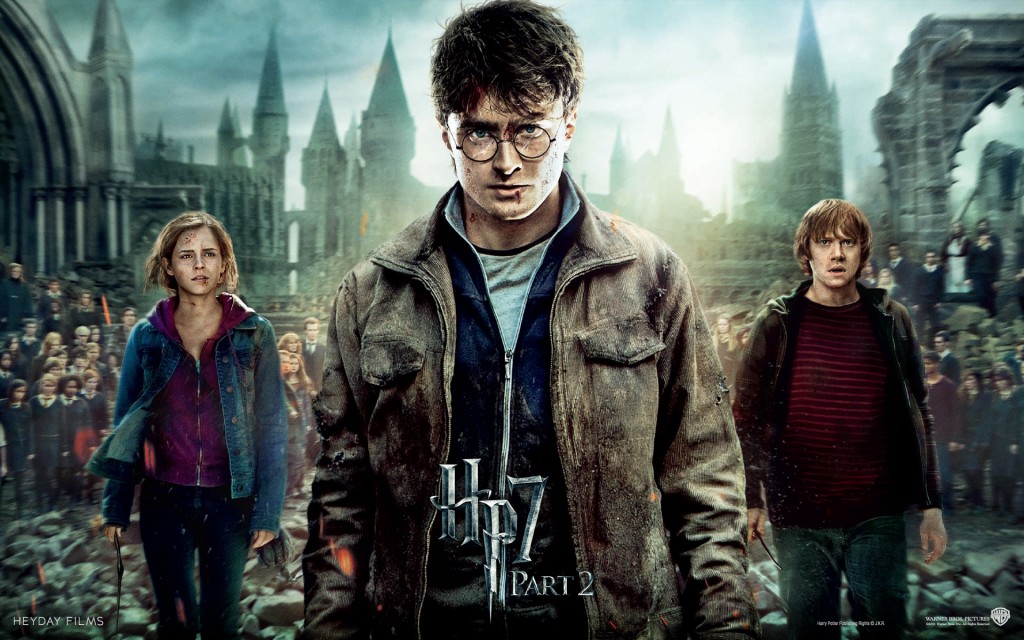
Harry Potter and the Deathly Hallows: Part 2

Almer S. Tigelaar 21 / 07 / 2011, 09:00

This movie marks the end of a string of no less than eight films, started by Chris Colombus, of Home Alone fame, and finished with a more mature tone set by David Yates. The reason for splitting the last book of the series into two films was perhaps due to its length: nearly 800 pages. However, one can not entirely disregard a financial motivation either: the Harry Potter film franchise has been a massive success. Perhaps due to the split, the seventh movie: which is the first part of the last book, was a bit too lengthy and drawn out for my taste. It was also more grim than its predecessors, which is in-line with the source material. So, how satisfactory is this second part: the conclusion?

At the start of the film we jump immediately into the story: it feels more like returning after the break than the start of a new film. This is exactly what viewers would expect, so it seems like a good choice. Unfortunately, during the first twenty minutes, not everything feels solid: the pacing is slow, the tone a bit too serious and there’s distracting overuse of dramatic music at inappropriate moments. In all honesty: this would probably work if you would watch the first part immediately prior to seeing this movie. Nevertheless, the pieces of the movie fall in to place as Harry Potter reaches Hogwarts. From there on the pacing is good with pleasant acting thanks to the great ensemble cast. There are also enough sprinkles of humor from this point on to keep the movie from taking itself overly serious. Furthermore, the cinematography is excellent and the special effects are well done. Parts of the movie are clearly influenced by the feel of contemporary movies, particularly Lord of the Rings. The post-converted 3D is not over-used or distracting apart from some minor strobing in some scenes, but they might as well have left it out as far as I am concerned.

It is always difficult for film makers to adapt a book so loved by millions. The good source material if anything, makes this more of a challenge. Besides having less time for the build-up of characters, things that work well in books simply do not translate well to the big screen, particularly long stretches of monologue or dialogue. Fortunately, the film makers manage to keep the dialogue to an absolute minimum putting the focus where it belongs: the trials of the main characters. There are several changes with respect to the book. I will not spoil anything content-wise in this review, but with respect to the source material there are some more moments in the movie for Hermione, professor McGonagall and Neville Longbottom, and there’s less emphasis on the back story of Dumbledore’s family. Some changes have been made to be able to to play on the strengths of the medium: telling a visual story, I find that this predominantly works well.

All in all, this is a worthy closing to a long-running film franchise. A good job by David Yates and all the other people who have worked on this movie. It is understandable even for people that have not read the books, even though seeing the first part of the deathly hallows is mandatory. To be honest: if you haven’t read the book, you really should read that first as it contains a lot more detail and back story which will make you better able to understand the film, as well as appreciate the minor changes it makes for more effective visual storytelling. If you are looking for a movie with lots of action then this is certainly not for you, as action is used only as a story-telling device. This is a good choice, as it caters to those who have really come to love Harry Potter over the years. This is the best movie in the series: recommended!

Rating: ★★★★★★★★☆☆ 


Trailer hosted by Vimeo. Copyright © 2011 Warner Brother Pictures

read more 0 comments

Social Networking Services – Part I: A Brief History

Almer S. Tigelaar 19 / 07 / 2011, 09:00

From the Oscar-winning movie “The Social Network” to the recent introduction of Google Plus, no-one can deny it: on-line social networking services are here to stay. But, where did they come from and what does it mean for you and me?

All modern social networking services have the same basic structure: you create a profile with some information about yourself, add your friends as connections, and start sharing self-created content: short messages, photos, videos, websites, etcetera. It’s like having a broadcast channel with a guaranteed audience: the people you know. Why is this basic model so successful? My guess: it caters to the human desire to share.

History
The social potential of the Internet was obvious even back in 1995 when I first got Internet access. Back then there was a community in the Netherlands called “De Digitale Stad” (The Digital City). This is where I also hosted my first homepage, and yes: it did have tacky animated GIFs. Although, the digital city was not exactly comparable to the services available today, it did have the same community feel to it: publishing your own things on-line, and finding other as well as interacting with them.

While Sixdegrees.com pioneered some of what we view as a social networking service today, it were probably Friendster, MySpace and LinkedIn that gained widespread global popularity initially. In the Netherlands most people’s first experience was probably Hyves. The layout of Hyves was often criticised for allowing too much freedom leading to unreadable pages with `happy’ color schemes. However, Hyves offered what many people wanted: a quick way to create a homepage, and is still popular to this day. On the other side of the ocean it was Facebook that quietly took the lead from MySpace in 2008. While MySpace was launched before Facebook, and was for some time very popular among artists for showcasing music, it lost the lead firstly because its creators failed to rapidly innovate, and secondly because it was slower: Facebook invested a lot in making their service load and respond quickly which is a key factor in getting users and keeping them. StudiVZ successfully copycat Facebook and gained widespread popularity in Germany. Finally, there’s of course Twitter founded in 2006 which differentiated by heavily focusing on short real-time public messages.

Search-giant Google has had some trouble coming up with its own answer to the social networking explosion. Initially they launched Orkut around the same time as Facebook. Even though Orkut was successful in India and Brazil, it never caught on globally. They tried to take on Twitter with Buzz, and Google Wave was intended to be a completely new collaboration experience, but was discontinued. Recently the company launched Google Plus which is receiving mixed to positive reactions. However, given its rapid adoption my guess is that it will be successful and provide some serious competition for Facebook: the current global market leader. Nevertheless, it’s probably obvious to you by now: these services tend to come and go. We don’t know what will be the Facebook or Twitter of tomorrow, and it may very well be a service that no one has heard of yet.

Curious on how you can leverage social networking services? Read the second part of this article.

read more 1 comments

How to Shoot Better Film with your Mobile

Almer S. Tigelaar 13 / 07 / 2011, 09:00

Many people have it nowadays: a mobile phone that includes a camera that you can use to shoot film. While the output quality of such a device is not great compared to a camcorder, DSLR or videocamera, it has one prime advantage: you always carry it with you. So, why not use it? Below are some tips for more effectively using your mobile device to shoot better videos.

Tip #1: Always record in the highest quality
Mobile phones have plenty of space available from the get go, and if not: they can easily be extended with a larger memory card. Hence, there is no compelling reason to use low quality video recording settings. As a rule of thumb: always set your mobile video application to the highest recording quality available, on modern phones this is usually 720p.

Tip #2: Leave the other camera settings alone
Camera applications come with a variety of manual settings, such as toning the image, tweaking contrast and brightness, or using digital zoom. I suggest that you stay away from these options unless you really know what you are doing. Most of these settings apply effects that are usually better applied in post-production during the editing process. By selecting some fancy looking effect you risk ruining your source material, as the effect of filters can often be difficult to see very well on a small screen. There can be circumstances where it is useful to manually adjust the white balance setting, but most of the time the built-in software will do fine on its own.

Tip #3: Record with sufficient light
The portability of cameras in phones comes at a cost: a tiny sensor – the part that actually captures the image. Unfortunately, small sensors make it very difficult to shoot nice film in the dark without significantly sacrificing image quality. Less light means that the exposure time will need to be longer to actually capture enough light. Mobile phones bring down the video frame rate dynamically in order to do this which results in choppy video: not exactly a feast for the eye. Besides this they usually also crank up the gain on the sensor which makes the image very noisy. So, it is best to record in sunlight if you can, or bright indoor light. Of course: sometimes this is impossible and you’ll have to compromise quality in order to actually capture a moment.

Tip #4: Keep it steady
Many people record while holding their mobile device with only one hand. My advice: don’t do that! Instead hold your phone firmly on both sides between your thumb and index finger. Some people have a steady hand and don’t require anything beyond this technique. However, if you are a particularly shaky person, try to lock your elbows against your sides, stand with your legs slightly spread and try to hold your breath for a couple of seconds to get a really steady shot.

Tip #5: But, use gentle motion as well
Any motion in your video should be a deliberate choice. Try to avoid jerky movements and keep it nice and smooth. You’ll primarily want to use panning motions: rotating the camera from left to right or right to left. Other motion includes tilting: up-down. Optically zooming is impossible with at least all mobile phones I know of, and: please do not use the digital zoom as it leads to really poor quality video. Although with a fixed lens you can’t really zoom, you can use your arms to create a limited dolly-shot effect[1]: move them outwards from your body to the subject your filming to dolly in and back towards your body to dolly out.

You can’t really use a tripod or monopod with most of these devices, but you can be creative and use other tools or your own body to create great shots. For example: bend your knees and from that position slowly stand upright while you pan or tilt the camera. You can get very nice motion shots with this technique. Try to avoid walking if you can, or walk very slowly. Also, if you have a car kit or dock you can reverse mount your mobile phone in these to create shots from fixed spots, but: take care not to damage your phone.

Mobile phone camera’s, like many professional camera’s nowadays use CMOS sensors. The downside of these sensors is that they are subject to rolling shutter. This means that when you pan the camera quickly, or something moves quickly,  an object that is standing straight in reality appears skewed in the recording. This is the reason why your movements should not be too fast. See the video below for a demonstration of this effect.

Tip #6: Frame properly with the rule of thirds
A simple rule of thumb famous in both photography and film is the rule of thirds. Imagine two equally spaced lines in your image horizontally and two vertically as shown here:

The idea is to use these orientation lines to properly align your subject. For a close-up shot the top horizontal line should be aligned with the eyes of the subject and either the left eye should be aligned with the leftmost vertical line, or the right eye with the rightmost vertical line. When taking wider shots the whole body may line up with one of the vertical lines, whereas the head is placed at one of the top intersections as in the image below. Of course, your subject need not be a person, but can be any object.

Tip #7: Don’t rely on the phone for quality audio
The biggest caveats of shooting film with a mobile telephone is not so much the image quality, but rather the abysmal sound. Most phone manufacturers seem to think that people play back film shot on a mobile phone with that same mobile phone, and for those instances the audio is just fine. However, for listening on the Internet, let alone playback on home theatre equipment, the sound just plain sucks. Unfortunately, there is not so much you can do about this. However, if you have the money you can consider buying a portable audio recorder. Many people, including me, own a Zoom H1 for such occasions. Devices like these are also pocket-sized and can easily be used to record high quality audio anywhere. You need to sync it up in post-production of course, but this can make your recording of a gig you went to that much more memorable.

So, now you have enough tips: start shooting some video :) As with anything, the trick to getting better at this is doing it a lot, making mistakes and learning from them.

read more 0 comments

What is Free Software and Open Source?

Almer S. Tigelaar 09 / 07 / 2011, 09:00

Shows a big red button with the word Free on it

There are many people that are unaware of what free software is and what open source software is, and why it matters. In this post I’ll try to shed some light on this.

When people hear `free software’ they usually think of software that does not cost anything in terms of money, which is not the right definition. The word `free’ in free software is free as in speech, not free as in beer. So, what does this actually mean in terms of computer software? To understand this we first need a basic understanding of what a computer program actually is. A computer processor can be operated via an instruction set which allows performing many low-level operations such as adding two numbers together. These instructions are numeric codes, which are very hard to understand for a human: imagine that you would have to type a text and instead of using a – z you had to use the numbers 1 – 26 for each letter. That would be terribly difficult to read and write! So, most computer programs are written in readable text which contains statements such as “x = 3 + 5″ instead of something like “1001 1100 1010″. This written text is called the source code, which is like a blueprint of the program, and can not be interpreted by a machine directly. Source code first has to be translated into a binary machine representation: the numeric codes I spoke of before. This translation process is called either compiling or interpreting[1]. After this step we can actually run the program and interact with it. So, we have a distinction between the source code and the binary.

Many companies that make computer software only distribute the binary to their customers and keep the source code locked away. These companies see the source code as their intellectual property which they must protect. Let’s go back to free software again and consider what makes a particular piece of software free as in speech: four main points. Firstly, the freedom to run the software for any purpose. This means that, for example, you can not distribute a video editor with the restriction that you can not use it to produce a commercial. Secondly, the freedom to study how the program works and to change it to suit your own needs. For this having the source code is a necessity. Thirdly, the freedom to distribute copies of the original program so you can share it with your friends. And finally: the freedom to distribute the modifications you make to the program to others. So, now you understand that besides the binary you also need the source code in order for something to be free software.

Undoubtedly these definitions will give you a lot to think about. Most people assume that you can not make money when you make free software. However, this is untrue as there are many successful companies out there that create and share free software. These companies realise that the real value of computer software is not in the source code, but in the people with the expertise about how the software works. Just like it takes time and practice for a musician to learn to play a musical instrument, it also takes time for a programmer to familiarise himself with a piece of software. Contrary to popular belief making computer programs is primarily a creative endeavour with a significant social component as well. Everyone who has ever written a report or paper knows the value of other people reviewing your work. The same is true for computer software: if more people read it, give feedback and fix errors, the quality of the software improves. And when the source code is available: it is much easier for people to participate in this process.

Now, this still leaves us with the question: what is open source? Is it exactly the same? Well, most open source software is also free software, which may be somewhat confusing. The main difference between the two is philosophical. The free software movement considers non-free software to be undesirable, and is social in nature: its emphasis is on changing people’s behaviour so that they create, use and share free software instead of alternatives. In contrast, the open source movement originated in the nineties as a pragmatic, liberal view on free software. Therefore it is slightly more permissive: some things that are not free software are open source. The difference is also emphasised in the concepts themselves: free software with “free as in speech” as the main issue, and open source software with an emphasis on the pragmatic advantages of having the source code openly available. Since there is a relatively large overlap between the programs these two concepts cover, people commonly use the term Free and Open Source Software (FOSS) to refer to both.

So, have you used free and open source software? It is quite likely that you have! Are you running Mozilla Firefox or Google Chrome as your Internet browser? Both are free software. Many websites you visits are powered by the Apache web server, which is open source. Are you perhaps using an Android telephone? The operating system kernel these phones use is Linux, which is free software. You are probably using many more pieces of free and open source software than you realise. Notice that many of these software products have been created by successful companies and not by individuals programming in their basements[2]. Here is a 2008 video with Stephen Fry giving a quick explanation and his view on free software:

Whether or not free and open source software matters to you personally is entirely up to you. But at least the next time anyone asks you what free or open source software is: now you know the answer.

Find out more:


read more 1 comments

Transformers: Dark of the Moon

Almer S. Tigelaar 06 / 07 / 2011, 09:00

Shows the main characters with transformers behind them

The first Transformers movie was a pleasant surprise, the second a let down with a confusing haphazard plot. A friend told me that they should have left the Transformers franchise alone: “Don’t taint my childhood memories”. The best way to deal with that: skip it if you feel nostalgic about the subject matter. So, is the third instalment any good? Does it bring the franchise back to its initial glory? Let’s find out.

Transformers Dark of the Moon starts with a spectacular moon landing that ties in the Transformer’s story with real history. Admittedly, this came across better in the teaser trailer than in the theatrical movie. After this, we return to the familiar character of Sam Witwicky and his sexy girlfriend this time portrayed by Rosie Huntington-Whiteley. The relationship between Witwicky and his car Bumblebee is put to good use throughout. In the first section Sam is eagerly looking to find a job: the comical focus of the movie. This section is relatively slow and light, which works well to draw viewers in and prepare them for the more serious tone in the later sections. Technically, the movie is full of typical Michael Bay shots: showing the main characters from an upward off-angle and movie poster like shots emphasizing the relationship between characters. All things that we have seen before in movies like Bad Boys and Pearl Harbor.

The middle section of the movie is where Dark of the Moon excels. There are a number of original plot twists there. Good supporting roles from Alan Tudyk and Ken Jeong prevent the movie from taking itself too seriously. The confusing and gripping situations in which the main characters are thrown and the fact that during most of the middle section we remain closely with them makes this part particularly engaging and memorable. However, shortly after the break, after scenes taking place in a collapsing building, the movie loses its focus. There are, for my taste, too many scenes in which Optimus Prime comes to save the day out of nowhere. The finale is also drawn out, the last sixty minutes could have been told in half the time. Although, it has to be said: lovers of an action-packed special effects extravaganza will not be disappointed by this part. The Transformers are extremely well modelled and the excellent audio design gives a familiar feel making them very believable. There are few noticeable special effect flaws, and, fortunately, the 3D does not distract and is never overused: there is very little visual strobing and jitter.

Even though it is somewhat unevenly paced, it is almost on par with the first movie in the series, and a lot better than the second: one we’d perhaps better forget about. If you like Transformers, Michael Bay movies or action-packed summer blockbusters then Transformers Dark of the Moon is for you.

Rating: ★★★★★★★☆☆☆ 

Official Site | IMDB | Wikipedia

Tip: Watch the excellent Teaser Trailer first.


Trailer hosted by Vimeo, Copyright (C) 2011 Paramount Pictures.

read more 0 comments

Source Code

Almer S. Tigelaar 04 / 07 / 2011, 09:00

Shows the main character running towards the viewer surrounded by flying leaflets with visual memories.

The premise of Source Code may sound somewhat boring: the same eight minutes in a passenger train repeated over and over again. However, the film makers manage to keep each iteration interesting by varying the story, as well as the perspectives. In the first few minutes the main plot line is revealed: the lead character, Colter Stevens, is supposed to identify the person planting a bomb on the train. He is repeatedly sent back to find out the identity of this person via the so-called source code. As a software developer I honestly feel that ‘source code’ is somewhat of a misnomer, but I am willing to let that one slide.

The film was directed by Duncan Jones, of Moon fame and is excellently paced throughout. Even though the plot surrounding the bomber is weak, the film is saved by Jake Gyllenhaal acting at his best in the lead role: I am impressed. All the more important since the film hinges strongly on its lead, more so than any of the other characters. Although, the role of Vera Farmiga is memorable as well. The chemistry between Jake Gyllenhaal and Michelle Monaghan is used for function and does not feel contrived or overblown at any point. The ending is philosophical enough to really make you think. Source Code is an odd mix between Groundhog Day, minus the humor, Robocop and some elements of The Butterfly Effect. Nevertheless, it manages to convince and entertain. Recommended for those who like plots revolving around time manipulation as well as people with an interest in good thrillers with a light science fiction flavour.

Rating: ★★★★★★★☆☆☆ 

Official Site | IMDB | Wikipedia


Trailer Hosted by YouTube, Copyright © Summit Pictures.

read more 0 comments

Kinetic Typography

Almer S. Tigelaar 02 / 07 / 2011, 16:00

It’s weekend, so time for something light. I came across a cool form of expression known as kinetic typography. This is often used in commercials. The concept is to animate text in sync with music, dialogue, or an idea being presented. Here’s a relatively subtle example, that also mixes other animation techniques, by Patrick Clair from Vimeo:

Of course, this is not limited to commercials. Movie enthusiast have used this technique as well to depict some scenes from their favourite movies. A few examples that distinguish themselves by properly capturing the atmosphere of the scene they portray:

From Pulp Fiction (1994)
Warning: this contains language which may be considered offensive by some. Watch at your own discretion.

The contrast between the characters is very well expressed here by the font used. The framing and timing of the animation also leaves no doubt about who’s the most dominant in the scene. Of course: this example is helped a lot by excellent acting in the source material from Samuel L. Jackson.

From Requiem for a Dream (2000)

This is an intensely laden dialogue which is emphasised by the rapid somewhat jittery motions of the text. What sets this apart is the appropriately chosen animation style for letting words appear and disappear, for example: when the female character says “poof”.

And of course, sports events are a good target too. Even though, I don’t speak Spanish, I certainly can understand what’s going on here:

Kinetic typography is relatively easy to do compared with, say 3D animation or live action filming. This relatively low barrier to entry also, admittedly, leads to a lot of poor quality stuff. Thus, it’s quite interesting to see what sets apart the better ones, as in the examples above, from the rest. As with anything it is largely a matter of having a good sense for what is being expressed in the source material, artistic skills, and a big dose of creativity.

More examples at Typegoodness

read more 0 comments

Puzzle #1: The Student Admission Problem

Almer S. Tigelaar 01 / 07 / 2011, 09:00

Background: I will occasionally present a small (mathematical) puzzle here. These are a tribute to the column “Vuiks Verhandelingen”, written by Kees Vuik which regularly appeared in the Dutch PCM Magazine nearly a decade ago. Sometimes I may think of them myself, and sometimes they may come from elsewhere.

Let’s get started: 114 students applied for a specific study, only 100 were eventually admitted by lottery. Among the 114 students were 5 foreign students. However, none of these foreigners were among the 100 that were admitted. Intuitively this seems quite unlikely. But how unlikely is it really? Were the foreigners intentionally not admitted?

Your task: find the probability that the 5 foreign students were left out due to chance. This can be solved with basic knowledge of probability and set theory. First try it yourself, then click below to expand the solution and check your answer.

More »

Tip: if you are not too familiar with mathematical notation, don’t be intimidated by it: it’s just a way to formally write things down, and the notation here should be easy to follow. I’ve added some footnotes to help: hover over them with your mousepointer to see an explanation.

Definitions
We start with some generic definitions:

  • S is the set of all students that applied.
  • F is the subset of S which is foreign.
  • n is the number of students we may select from S (without replacement[1]).
  • The resulting selection we call set L (where L is a subset of S with cardinality[2] n )

Let’s fill out the variables above for this specific case:

  • There are 114 students in total: \#S=114
  • Of which 5 are foreigners: F\subset S\wedge\#F=5[3]
  • We may select 100 students: n=100

Problem:
What is the probability that we select no foreign student when we choose 100 students out of the 114 that applied? Formal: what is the probability that the intersection of F and L is empty?: P\left(F\cap L=\varnothing\right)

Solution:

  1. We know that there are \binom{\#S}{n} ways[4] in which we can select n students from the \#S (without replacement).
  2. There are \binom{\#F}{k} ways to select k students from the foreign subset.
  3. Given (2) there are \binom{\#S-\#F}{n-k} ways to select the remaining n - k students.
  4. Combining (1-3) we get:P\left(F\cap L=\varnothing\right)=\frac{\binom{\#F}{k}\cdot\binom{\#S-\#F}{n-k}}{\binom{\#S}{n}}

In this last step we effectively state that the probability is the number of ways in which we can select k and n - k students, relative to the total number of possible selections we can make. It is a generic solution for any set sizes, for this specific instance we take the problem specific values and simply substitute them:

P\left(F\cap L=\varnothing\right)=\frac{\binom{5}{0}\cdot\binom{114-5}{100-0}}{\binom{114}{100}}=\frac{\binom{5}{0}\cdot\binom{109}{100}}{\binom{114}{100}}=\frac{\binom{109}{100}}{\binom{114}{100}}\thickapprox1.36\cdot10^{-5}

All the values are as specified in the problem specific definition. The value of k is 0, since we are interested in the probability of selecting 0 students from the Foreign group. We see that the problem simplifies, since \binom{5}{0}=1.

We can conclude that the probability of selecting none of the 5 foreign students is quite low: 0.00136 %

The probability that the lottery was unfair can be deduced from this:
P\left(F\cap L\neq\varnothing\right)=1-P\left(F\cap L=\varnothing\right)=1-1.36\cdot10^{-5}=0.9999864

Which is 99.99864%. Indeed, it is very likely that at least one foreign student would have been selected. Hence we can state that it is likely that the lottery applied was unfair in this case and that the probability of a foreign student of being selected must have been much lower than that of a local student, or even zero.

read more 2 comments