recent comments

recent articles

  • How long would it take to read Wikipedia?

    Almer S. Tigelaar 21 / 02 / 2012

    Wikipedia has become the de facto encyclopedia on the Internet. A traditional encyclopedia spans many textbook volumes which would take any normal person ages to read. Few people would likely engage in such an endeavor. However, since Wikipedia is readily accessible: should you take up the challenge?

    read more 0 comments
  • Life in a Day

    Almer S. Tigelaar 09 / 02 / 2012

    The premise behind the YouTube documentary “Life in a Day” is interesting: invite everyone around the world to shoot video on one specific day: July 24th 2010. Have people upload their raw footage and edit it so it becomes a short, ninety minute, documentary that chronicles a single day on our planet. Does this extreme form of crowdsourcing actually work?

    read more 0 comments
  • Top 8 Prejudices about Americans

    Almer S. Tigelaar 07 / 02 / 2012

    When travelling abroad it is difficult to go with an open mind. Despite our best efforts we bring with us an excess of prejudice shaped by our own culture and view of the destination country. So to it was for me when I visited the United States. When coming back, people at home are very insistent that you play into their prejudice regarding where you’ve been as well, perhaps as a means of reinforcing their own identity.

    read more 0 comments

Monthly Archives: July 2010

Query-Based Sampling using Snippets

Almer S. Tigelaar 23 / 07 / 2010, 11:11

Query-Based Sampling using Snippets
Tigelaar, A. S. & Hiemstra, D.

In Proceedings of LSDS-IR 2010, Geneva, Switzerland (pp. 9-14).

View in Repository

Abstract
Query-based sampling is a commonly used approach to model the content of servers. Conventionally, queries are sent to a server and the documents in the search results returned are downloaded in full as representation of the server’s content. We present an approach that uses the document snippets in the search results as samples instead of downloading the entire documents. We show this yields equal or better modeling performance for the same bandwidth consumption depending on collection characteristics, like document length distribution and homogeneity. Query-based sampling using snippets is a useful approach for real-world systems, since it requires no extra operations beyond exchanging queries and search results.

Presented at the Large-Scale Distributed Systems for Information Retrieval Workshop on July 23rd in Geneva, Switzerland.

sigir2010-13
More Photos

Large-Scale and Distributed Systems for Information Retrieval Workshop Logo

read more 0 comments

Bertold van Voorst: Cluster-based Collection Selection in Uncooperative Distributed Information Retrieval

Almer S. Tigelaar 13 / 07 / 2010, 14:00

Cluster-based Collection Selection in Uncooperative Distributed Information Retrieval
by Bertold van Voorst

View in Repository

Abstract
The focus of this research is collection selection for distributed information retrieval. The collection descriptions that are necessary for selecting the most relevant collections are often created from information gathered by random sampling. Collection selection based on an incomplete index constructed by using random sampling instead of a full index leads to inferior results.

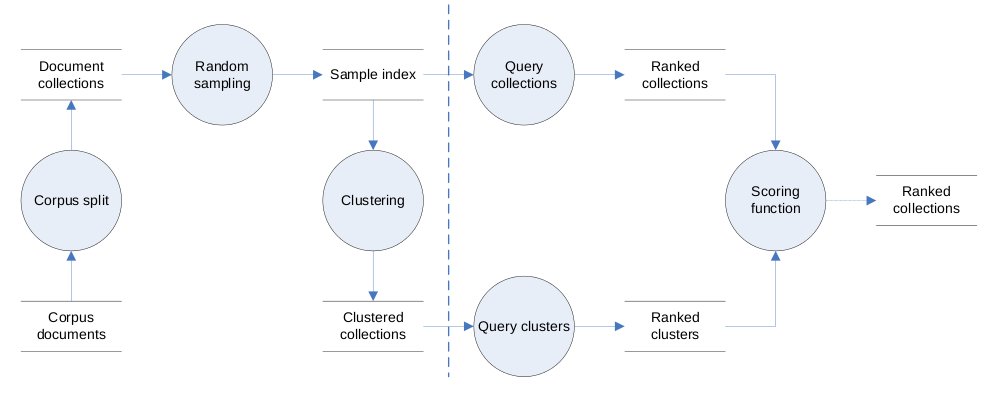
In this research we propose to use collection clustering to  compensate for the incompleteness of the indexes. When collection clustering is used we do not only select the collections that are considered relevant based on their collection descriptions, but also collections that have similar content in their indexes. Most existing cluster algorithms require the specification of the number of clusters prior to execution. We describe a new clustering  algorithm that allows us to specify the sizes of the produced clusters instead of the number of clusters.

Our experiments show that that collection clustering can indeed improve the performance of distributed information retrieval systems that use random sampling. There is not much difference in retrieval performance between our clustering algorithm and the well-known k-means algorithm. We suggest to use the algorithm we proposed because it is more scalable.

read more 0 comments